Formal Half-Up Hairstyles for Long Hair: Styling Guide & Cuts That Balance Elegance and Wearability
Formal half-up hairstyles for long hair solve a useful problem: they give you the structure and occasion-ready detail of an updo without hiding the length you may want to show off.
The real decision is where that structure should sit. A sleek half ponytail draws the eye upward and keeps the front controlled. Twists and braids add detail across the back of the head. A half-up bun creates a stronger focal point, while softly pinned sections let curls and waves remain the main feature.
Long hair also changes how these styles behave. Dense lengths can pull on a small anchor. Very smooth hair may need more internal grip than the finished photograph reveals. Curly and coily hair brings its own volume and shrinkage, which can make a half-up design fuller without requiring the hair to be straightened first.
Use the finished silhouette, your event accessories, and how much movement you want through the loose lengths to narrow down the options.
Clean Half-Up Styles for a Formal, Refined Finish
Polished Half-Up Ponytail
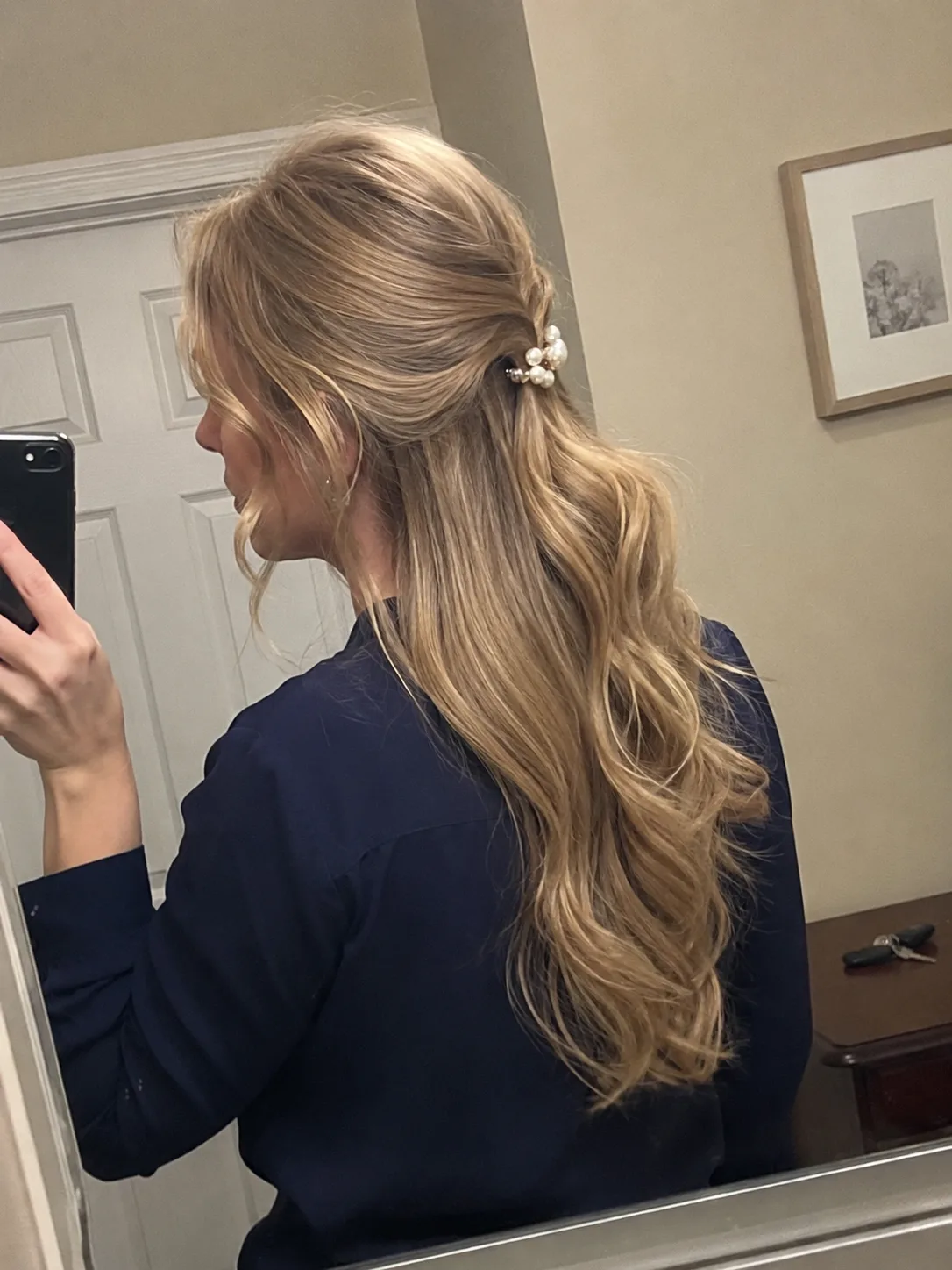
A smooth half ponytail is one of the strongest choices when your outfit, earrings, or neckline already carries plenty of detail. The upper section is directed cleanly toward a central anchor while the lower lengths remain loose. Wrapping a small section of hair around the elastic makes the construction look more finished. Straight, waved, curled, or stretched hair can all work; the key is keeping the transition into the ponytail neat without flattening every bit of movement at the crown.
Softly Lifted Half Ponytail
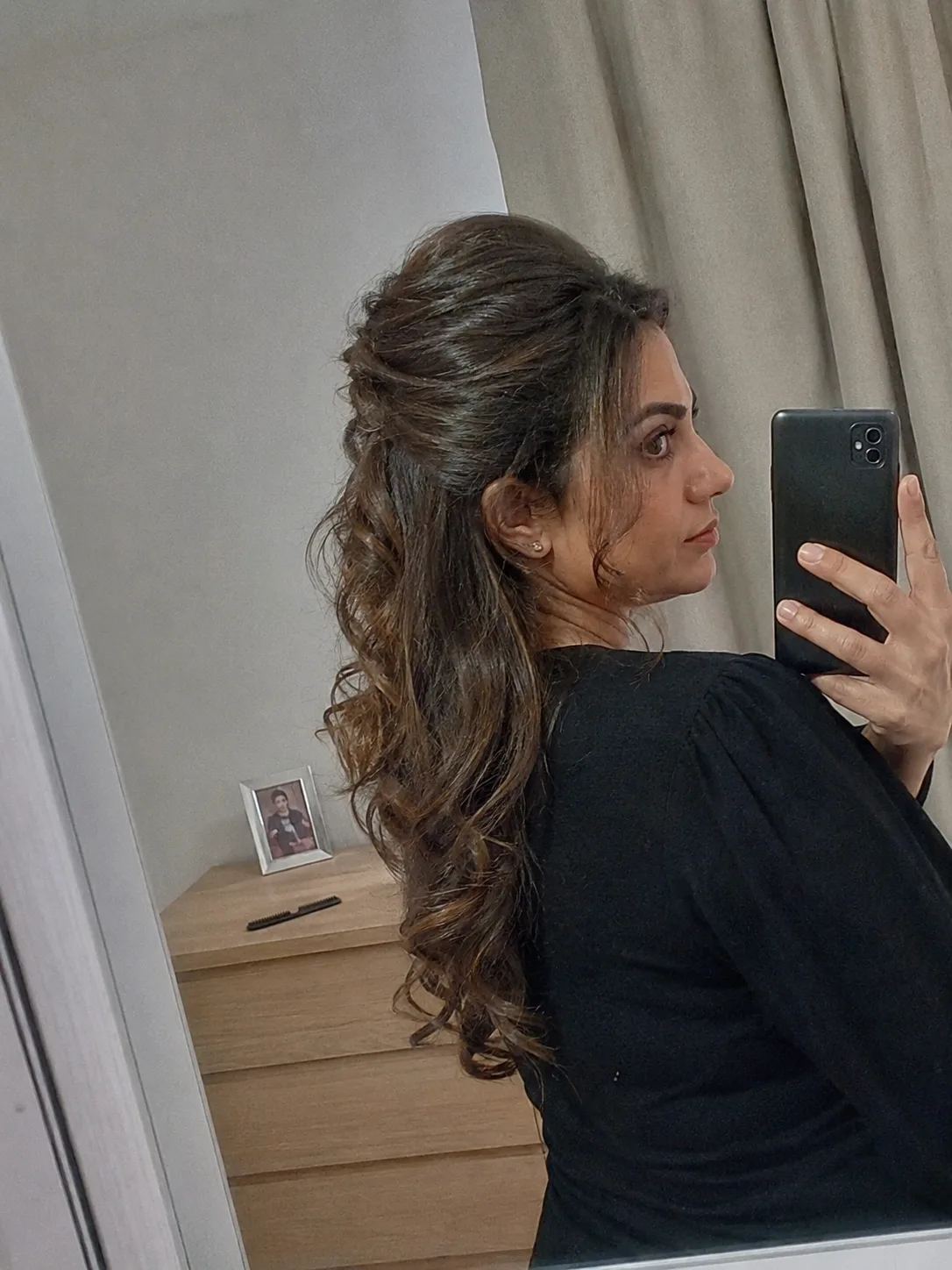
A little crown lift changes the character of a half ponytail considerably. Instead of pulling the upper section straight backward, the hair is shaped with some height before being secured.
That lift is useful for long hair because it keeps the style from looking visually heavy toward the lower half of the head. It also gives waves and curls more room to fall behind the shoulders without the top appearing flat.
The practical issue is support. Overworking the surface after creating volume can collapse it, while placing the anchor too low may drag the lifted section backward. This version works best when the crown is built first and the ponytail is secured without crushing the shape.
Half-Up French Twist
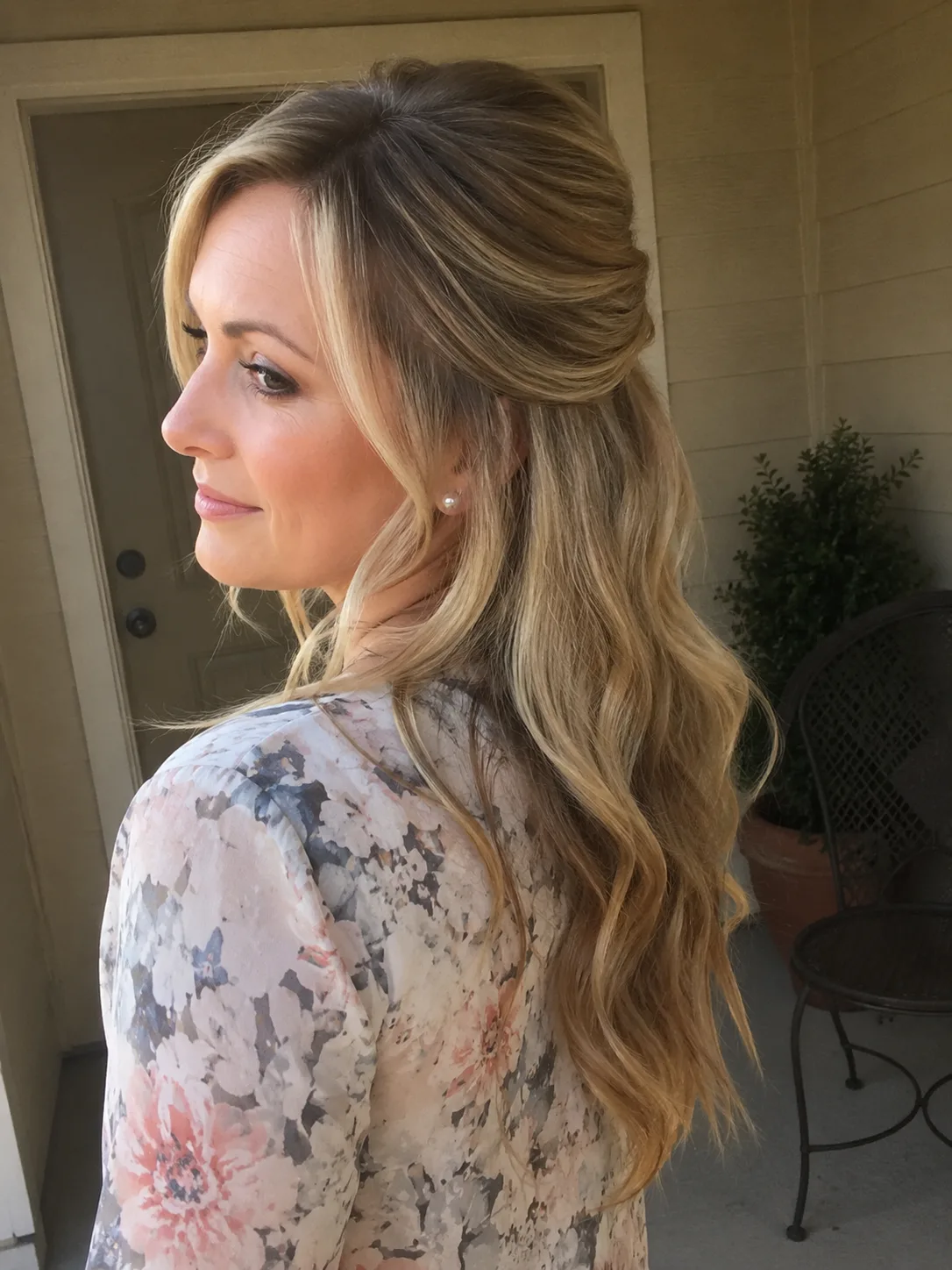
A French-twist-inspired half-up style gives you the vertical lines of a classic updo while leaving most of the length down. The upper section is gathered, rolled inward, and pinned through the center back instead of simply being tied with an elastic.
Long hair gives the roll enough material to look substantial, although very dense hair may need more carefully distributed pins. The style pairs particularly well with smoother waves because the structured upper section contrasts with movement below.
Sleek Side-Swept Half-Up Style
For an asymmetrical formal look, direct one front section across the back and secure it beneath hair from the opposite side. The result is quieter than a braid and softer than a centered ponytail, making it useful when you want the hair to frame one side of the face more visibly. Keep the crossing section wide enough to read as a deliberate shape rather than a stray pinned piece.
Twists That Add Detail Without Hiding Your Length
Double-Twist Half-Up Style
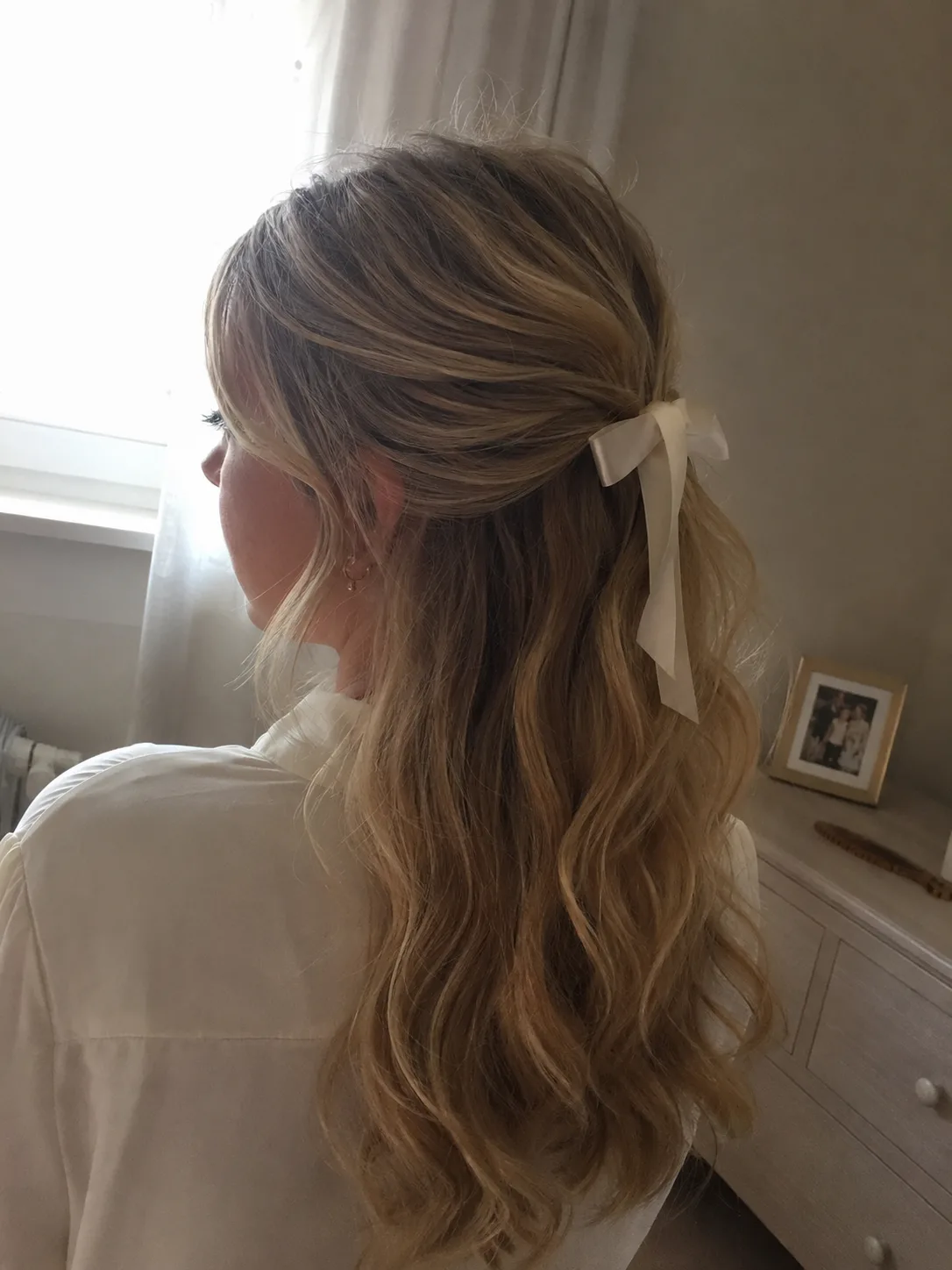
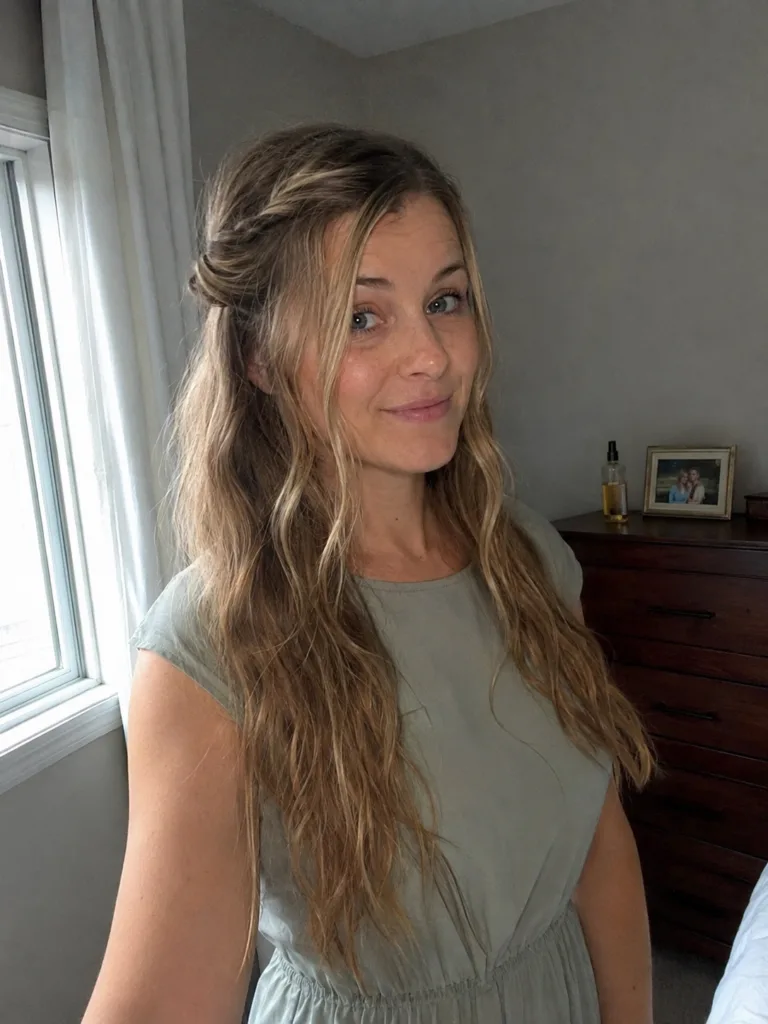
Two sections taken from around the temples can be twisted backward and joined at the center. It is simple construction, but the twist creates more surface detail than a plain half ponytail.
This option is especially useful on highlighted, balayaged, or naturally dimensional hair because the turning sections expose different parts of the strand. On one-tone hair, gently separating the outer edge of each twist can make the pattern easier to see without turning it into a loose, undone style.
Rope-Twist Crown
A rope twist produces a cleaner, more linear pattern than a soft two-strand twist. Each side section is twisted along its own length before the two sides meet behind the head.
The design works well for formal occasions where a full braid feels too decorative. It gives enough texture to make the back interesting while keeping the front relatively restrained.
Long hair doesn’t need to be incorporated into the entire twist. Using only the upper side sections leaves more length free and reduces bulk at the meeting point. Bobby pins can be placed beneath the twist so the hardware stays less visible.
Overlapping Twisted Sections
Instead of creating one twist from each side, several wider sections can cross and overlap across the back of the head. This gives the style a layered, almost woven appearance without requiring a traditional braid.
The construction is more forgiving when you want softness around the temples because every front strand doesn’t have to be swept into a single tight section. It is also useful for hair with natural wave or curl, where perfectly smooth overlapping panels may look less harmonious than sections that retain some texture.
Twisted Half-Up Knot
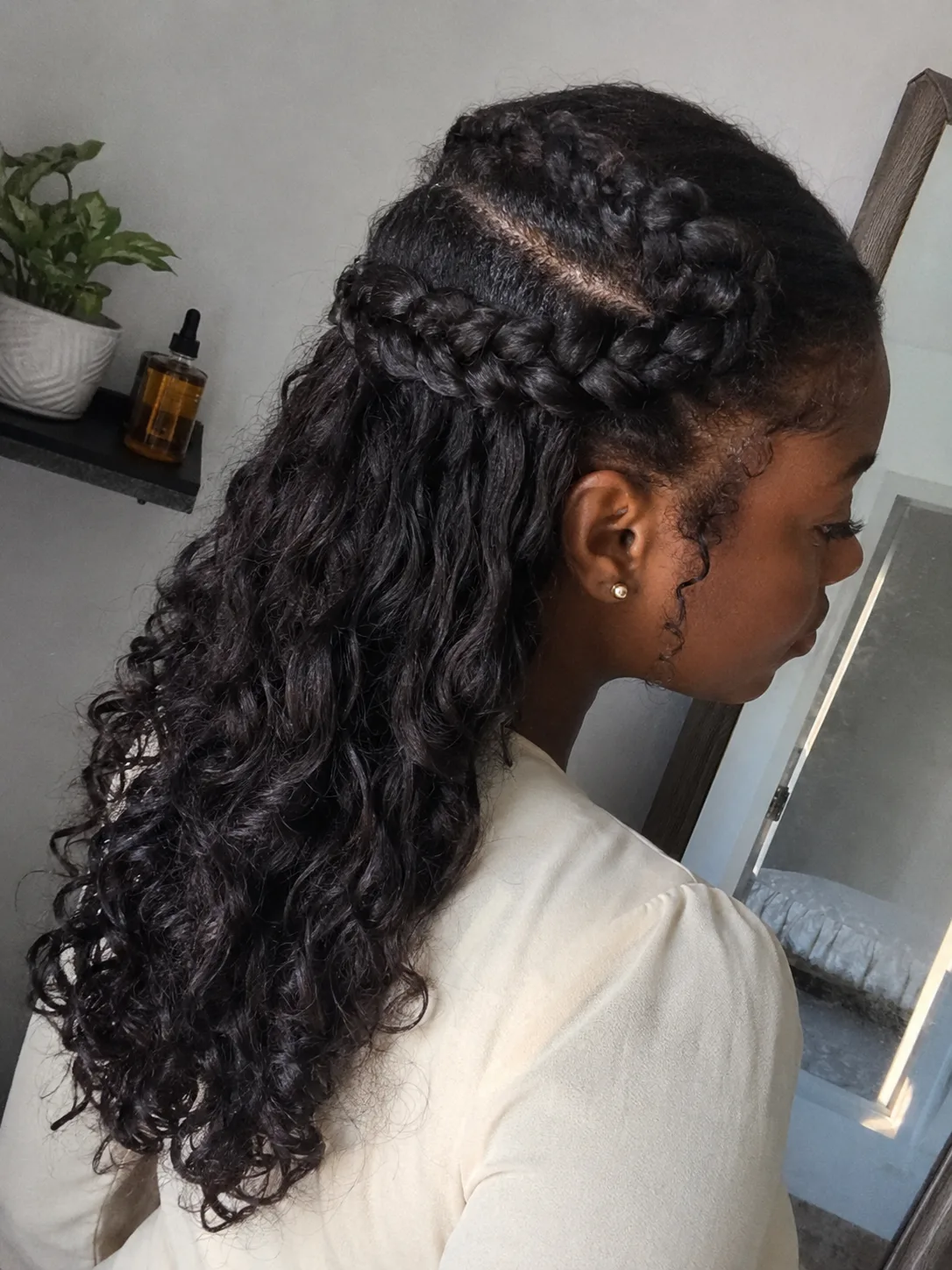
A half-up knot gives long hair a defined central feature without creating the full size of a bun. The upper sections are brought together, twisted, and tucked into a compact knot while the remaining hair falls freely. This is a good middle ground between romantic and architectural: more noticeable than basic twists, less dominant than a large top knot.
Braided Half-Up Hairstyles for Visible Formal Detail
Braided Crown With Loose Lengths
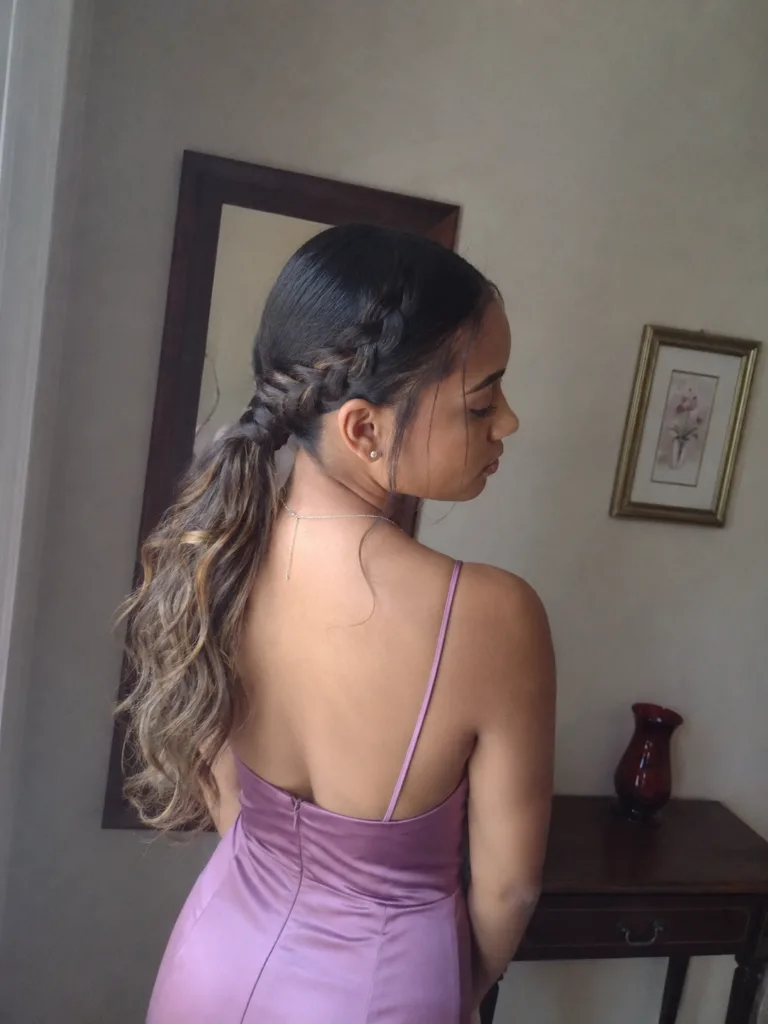
A braided crown creates a clear horizontal feature across the back of the head. Two braids can travel from the sides and meet centrally, or a longer braid can be positioned across the back depending on the construction.
This hairstyle earns its place at formal events because it reads from multiple angles. Photographs from behind capture the braid, while the front can remain soft, smooth, or naturally textured.
Consider how visible the braid will actually be in your hair. Dense curls can partially cover fine braid work, while very dark hair without much tonal variation may make intricate sections less obvious from a distance. A slightly wider braid often photographs more clearly than an extremely tight, narrow one.
Half-Up Fishtail Braid
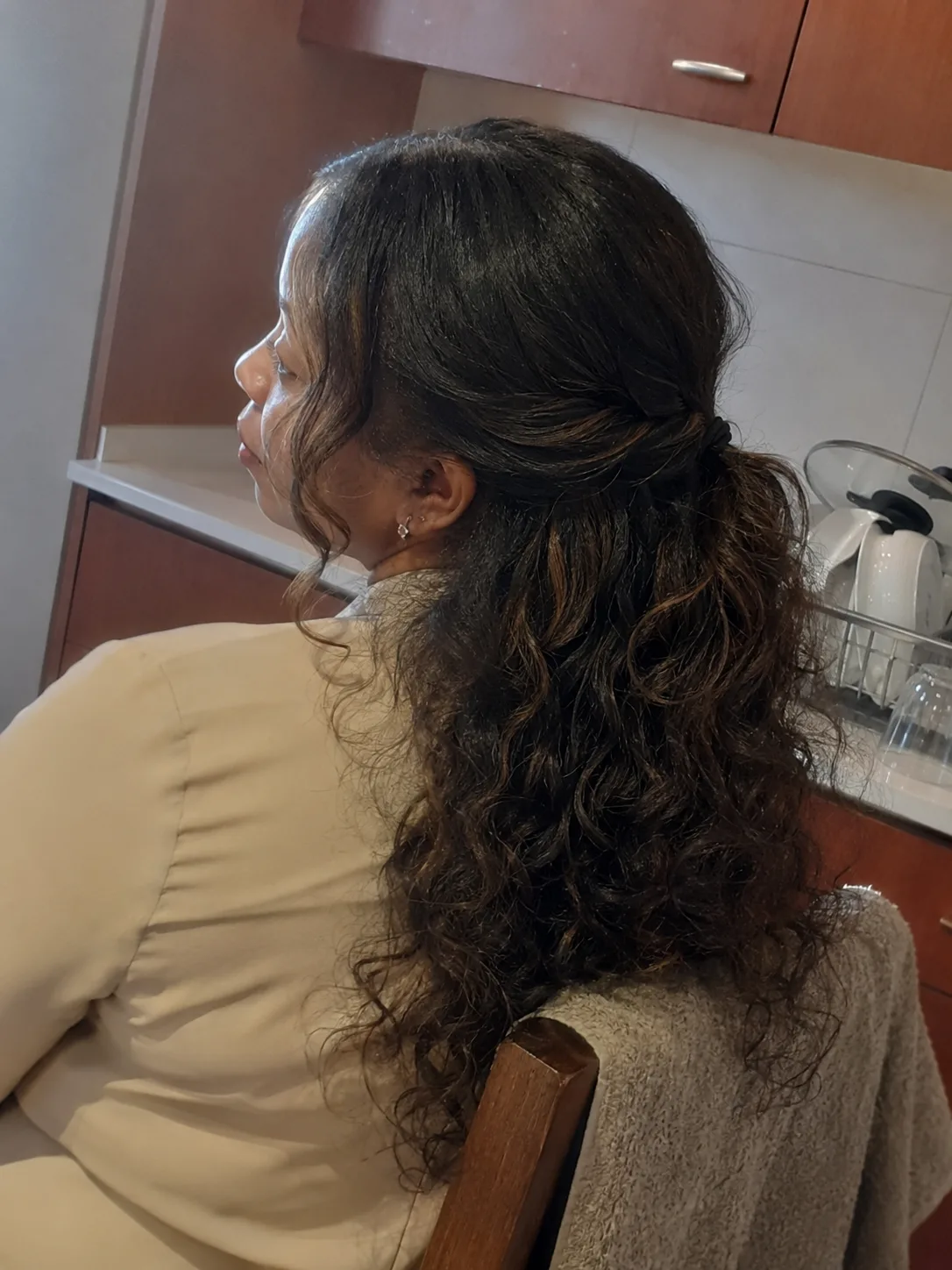
A fishtail braid gives the center back a narrower, more intricate pattern than a conventional three-strand braid. Only the upper section needs to be braided, so the majority of the length remains loose. It works particularly well when the braid is meant to be the main decoration and you don’t plan to add a large clip, bow, or comb over it.
Waterfall Braid With Waves
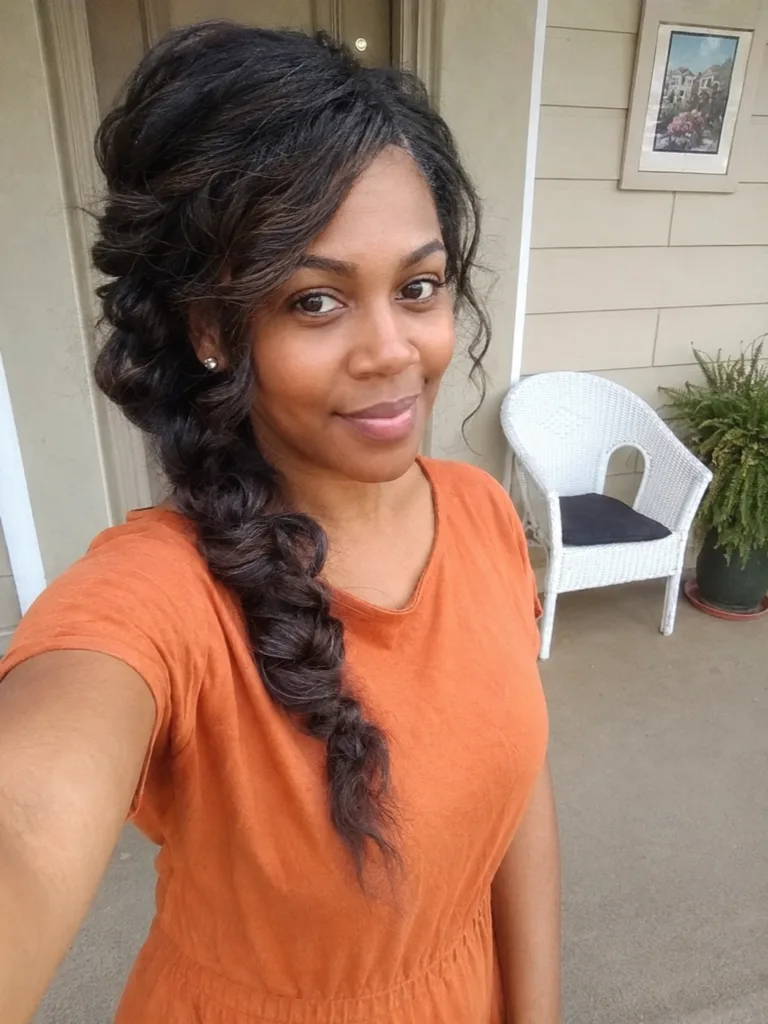
A waterfall braid is designed to release small sections of hair as the braid travels across the head. Those dropped sections blend into the loose lengths, making waves or curls part of the braid’s visual effect.
This style is more detail-dependent than a standard half-up braid. The pattern needs enough separation to remain visible, and the loose sections should fall cleanly through it. On highly textured hair, the same construction can look fuller and less linear, which can be beautiful but different from a smooth reference photo.
Half-Up Dutch Braid
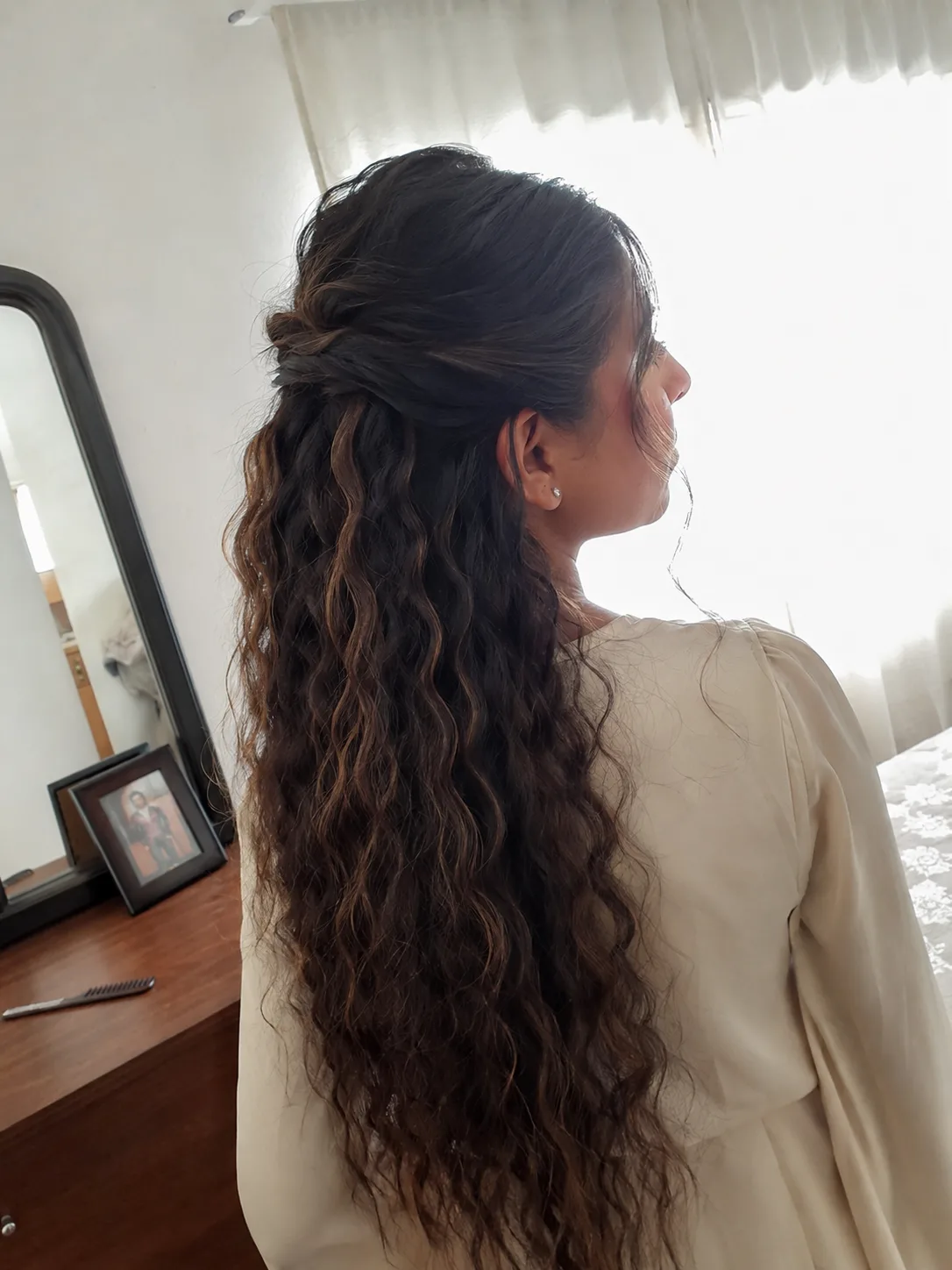
A Dutch braid sits more prominently on the surface because the braid structure is raised rather than tucked visually into the hair. Used only through the crown, it creates a strong central line before the rest of the hair falls loose.
This is a stronger choice than a delicate waterfall braid when you want the hairstyle to remain noticeable from across a room. It also works well when a small decorative pin will sit beside the braid instead of covering it.
Romantic Volume, Curls, and Soft Formal Shapes
Curled Half-Up Style With Crown Volume
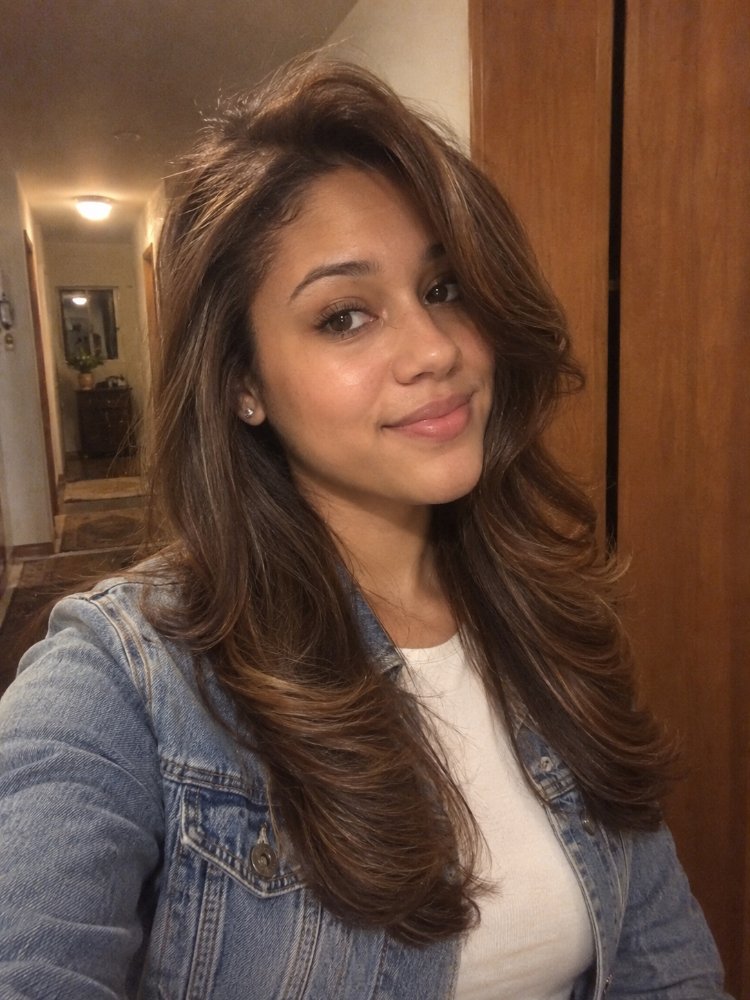
Big curls can become visually bottom-heavy on very long hair. Lifting and securing the crown redistributes some of that volume upward, so the style feels balanced from the side as well as the back.
The upper section doesn’t have to be perfectly smooth. Soft texture at the crown can blend more naturally into curled lengths than a hard, slick surface.
Curl placement matters more than curl uniformity. A few pieces falling forward around the face can soften the transition, while the loose hair behind the anchor needs enough separation to avoid forming one dense mass. The strongest version keeps the top controlled and lets most of the movement happen below it.
Half-Up Style for Natural Curls or Coils
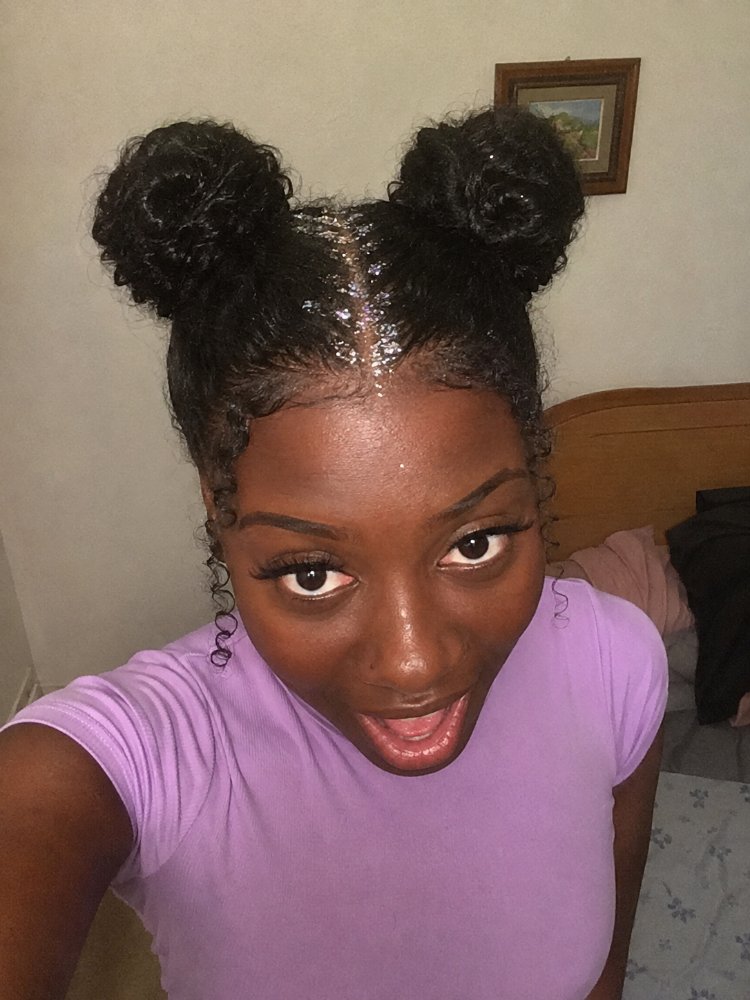
Natural curls and coils already provide much of the volume that formal half-up styling often tries to create. Gathering the upper section exposes the face and shifts fullness toward the back while leaving the lower curl pattern visible. The hair can be styled in its natural shrunken state or a stretched state depending on the result you want; straightening isn’t required to make the hairstyle formal.
Pinned-Back Hollywood Waves
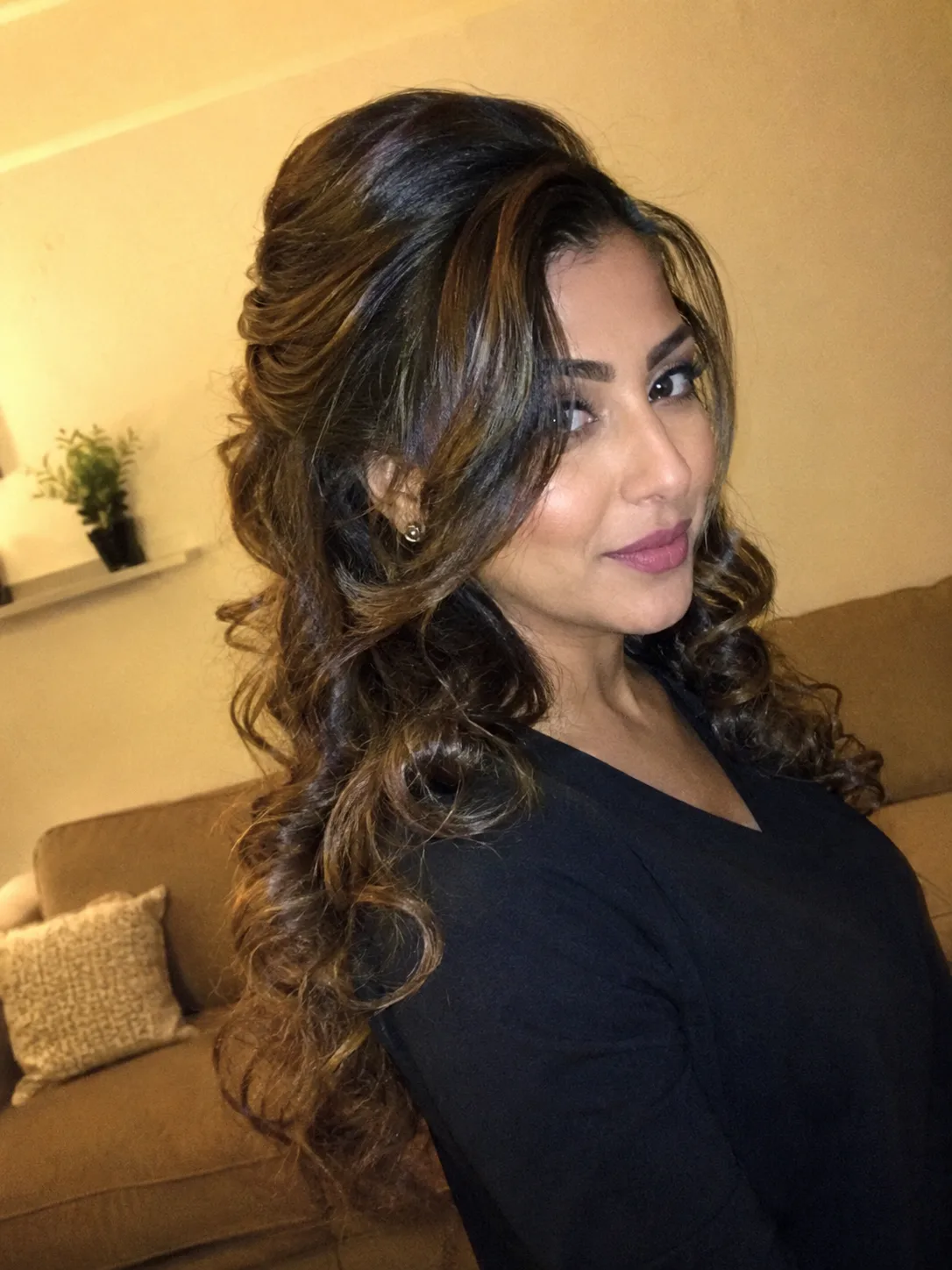
Classic directional waves can be adapted into a half-up style by pinning back the sections above the ears while preserving the larger wave pattern through the lengths.
This option is less about creating a visible ponytail or braid and more about controlling the front. The back remains dominated by glossy, continuous movement.
Because the wave pattern is the main feature, excessive sectioning can interrupt it. Pins should support the shape without turning the upper section into a separate hairstyle. This is particularly effective with open-back dresses or simple necklines where long, flowing hair is meant to remain part of the overall look.
Romantic Loose-Twist Half-Up Style
Some formal hairstyles look stronger with a little movement around the crown. Loose twists allow small bends and natural texture to remain visible rather than pulling everything into a perfectly flat surface.
The style pairs well with soft curls, waves, and textured blowouts. It is less forgiving in strong wind or during a highly active event than a compact ponytail or firm braid, so the softness is worth choosing when appearance matters more than maximum containment.
Half-Up Styles With a Stronger Focal Point
Half-Up Bun With Loose Waves
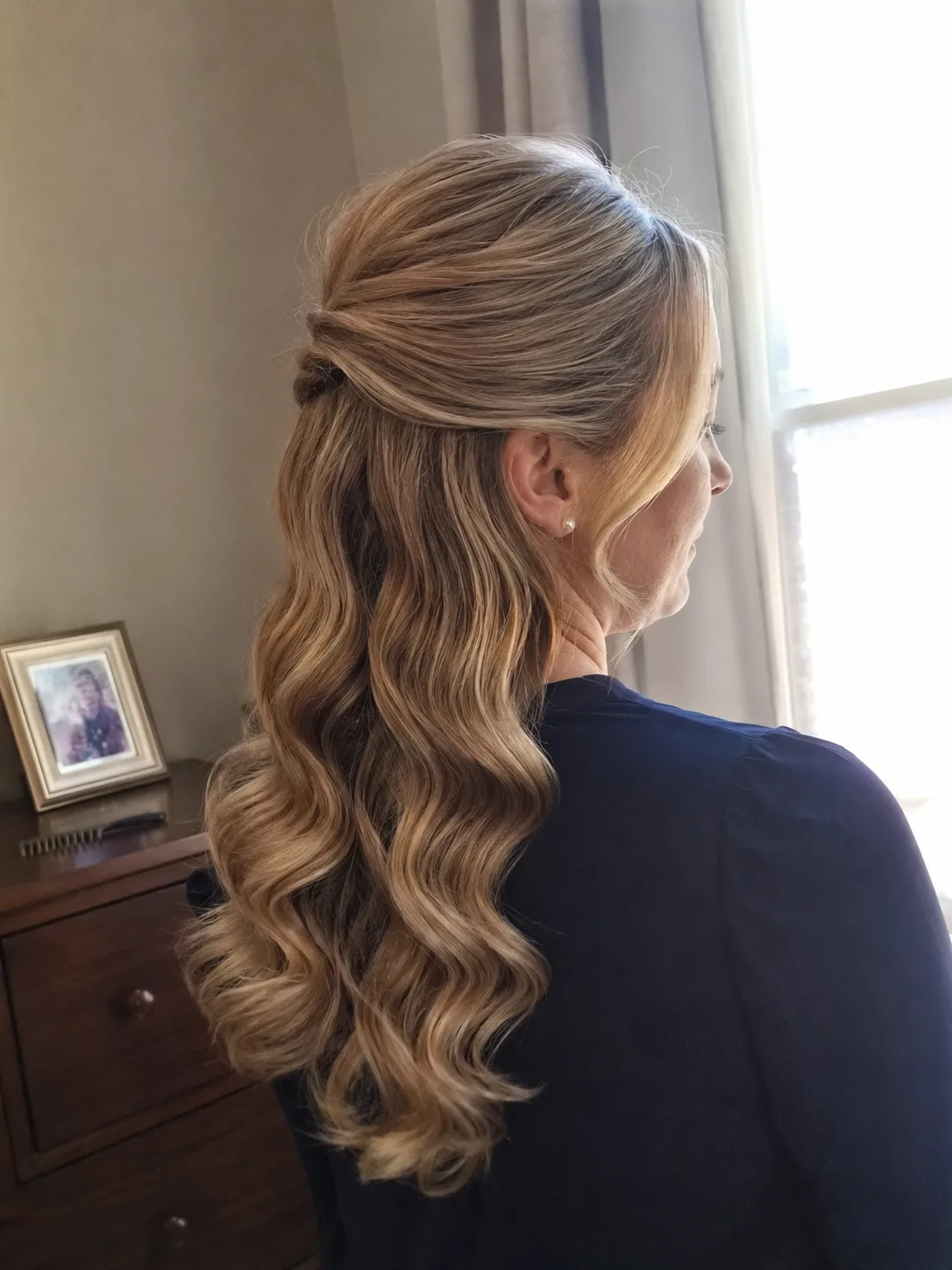
A half-up bun places the visual focus higher than most twisted or braided styles. The upper section is gathered into a compact bun while the rest stays down, giving you a clear shape at the crown without committing to a full updo. With very long or dense hair, using too much of the total hair in the bun can make it bulky and increase pulling at the anchor, so a smaller upper section is often the more wearable formal version.
Half-Up Hair Bow
A hair bow creates its decoration from the hair itself, making it one of the more distinctive formal options. The upper section is looped and shaped into two sides, with a central section covering the middle.
It works best when the bow is meant to be noticed. Hiding it beneath a large accessory defeats much of the construction, so earrings or smaller pins are usually easier companions than an oversized back-of-head piece. The loose lengths can stay straight for a sharper effect or curled for a softer one.
Match the Hairstyle to the Event, Not Just the Reference Photo
Formal hairstyles are usually chosen from photographs taken immediately after styling. Your event asks more of the hair than that single image shows.
A low or centered half-up anchor tends to interfere less with seating than a large bun positioned directly against the back of the head. A raised crown may be beautiful in standing photographs but needs to coexist with a veil, headpiece, graduation cap, or other accessory when one is part of the occasion.
The loose lengths matter too. Waist-length curls can catch beneath bag straps or become trapped behind you while seated. Smooth hair may rub against formal fabrics and separate more quickly than expected. Dense curls can retain more bulk around a decorative comb.
Long Hair Changes the Anchor More Than the Front View Suggests
The amount of hair gathered into the half-up section matters as much as the hairstyle name.
Very long, dense hair can make a small elastic or concentrated group of pins work harder than expected. A dramatic half-up bun, for example, places more hair at one fixed point than two side twists that spread their support across the back.
Fine strands and low density require different thinking. Fine describes strand diameter, while low density describes the amount of hair overall. A person can have fine strands and plenty of hair, or coarse strands with lower density. Pulling heavily on fragile strands can be uncomfortable, while taking too much hair from a lower-density head can leave the loose section looking sparse.
A formal hairstyle should feel secure during normal head movement without depending on painful tightness. Persistent pulling, stinging, scalp soreness, or visible stress around the hairline is a reason to change the construction rather than trying to tolerate it.
Accessories Should Support the Style Instead of Rebuilding It
Decorative combs, pins, pearls, bows, and clips work best after the hairstyle’s structure has been decided.
A braided crown already provides visual detail, so it usually needs less decoration than a simple half ponytail. A plain twisted style gives you more room for a decorative comb at the center. Hair bows and larger half-up buns are already focal points and can become visually crowded when another substantial accessory is placed directly beside them.
Check the hardware as carefully as the decoration. A heavy clip attached to a small section of hair can slide, pull, or rotate. A comb needs enough hair beneath it to stay stable. Bobby pins work better when they support the underlying construction rather than being expected to carry the entire hairstyle from the surface.
Veils deserve their own planning. Decide whether the veil comb will sit above, below, or within the half-up anchor before the final style is built. Otherwise the accessory can flatten crown volume or cover the braid you chose specifically for its detail.
Planning Your Formal Half-Up Hairstyle
Start with the version of your hair you actually intend to wear to the event. Natural curls, stretched coils, pressed hair, a blowout, straight lengths, and heat-styled waves all create different proportions even with the same half-up construction.
Bring reference images that show the back as well as the front. A front-facing photo can hide the size of the anchor, how much hair was gathered, and whether extensions or added pieces contributed to the volume.
Your consultation or styling plan should cover:
How much hair will remain loose.
Where the half-up section will sit.
Whether you want smoothness, natural texture, waves, or curls.
Which accessory needs to fit around the anchor.
Whether the style must accommodate a veil or headpiece.
How the loose length will interact with your neckline.
Whether you want visible braiding, twisting, or a cleaner finish.
A trial style is particularly useful when several elements have to occupy the same area of the head. Crown volume, a decorative comb, and a veil may all look straightforward in separate photographs but compete for the same space when combined.
Keeping a Half-Up Style Looking Formal Through the Event
The loose half of the hairstyle usually needs as much attention as the pinned section.
Before styling, detangle and prepare the hair according to the finish you want. Smooth styles benefit from an even surface before the anchor is created. Curls and waves should be shaped with the final half-up placement in mind so you aren’t repeatedly brushing through them later.
Carry only the touch-up tools that suit the actual construction. A few compatible pins can help a twisted section that loosens. A small styling product may help with surface flyaways. Rebuilding an intricate braid or hair bow in a restroom is far less practical, which makes secure initial construction more valuable for those styles.
Humidity, friction against clothing, and movement can all change the loose lengths. A little softening through curls or waves is often less distracting than a half-up anchor that visibly shifts. Prioritize the part of the hairstyle that provides its structure.
Related Hairstyles to Explore
- Formal hairstyles for long hair
- Elegant hairstyles for long hair formal
- Prom hairstyles for long hair
- Beach hairstyles for long hair
FAQs
Can half-up hairstyles look formal enough for a wedding or black-tie event?
Yes. The construction and finish determine how formal the style reads. A clean half ponytail, structured braid, French-twist detail, or carefully shaped waves can look fully occasion-appropriate. Accessories and the finish of the loose lengths can raise or lower the level of formality.
Which half-up hairstyle is most secure for very long hair?
A well-supported half ponytail or braided construction is usually more practical than a large, loosely pinned focal point when secure hold is the priority. Very dense or heavy lengths may benefit from distributing support across several pins or sections rather than relying on one small anchor.
Can I wear a formal half-up hairstyle with naturally curly or coily hair?
Absolutely. Curls and coils can remain in their natural state, be stretched, or be styled into a different curl pattern depending on your preference. Shrinkage affects the final length and volume, so assess the hairstyle in the state you plan to wear rather than judging it from a straight-hair reference image.
Do I need extensions for a formal half-up hairstyle?
No. Long natural hair already provides plenty of material for most half-up constructions. Added hair may be used for a specific amount of volume or length, but it also changes weight, attachment requirements, and the size of the anchor.
What half-up style works well with a veil?
Simple twists, a braided crown, and a structured half ponytail are useful starting points because they can leave a defined area for a veil comb. The exact placement should be planned before the hairstyle is finished so the veil doesn’t crush the feature you want visible.
Can fine hair wear a half-up formal style without looking flat?
Yes. Fine strands don’t automatically mean low density. Crown lift, a smaller half-up section, waves through the loose hair, or a braid with visible width can create more dimension without removing too much hair from the lower section. The strongest choice depends on how much hair you have as well as individual strand size.
Hair Texture & Upkeep Style Matcher
Select your natural hair texture and daily maintenance window to get an instant styling formula and heat safety cap.
Heat Cap: 320°F (160°C)
A versatile three-strand braid beginning at the parietal ridge, securing the top half while allowing natural wave texture to flow freely around the shoulders.
Conclusion
The most successful formal half-up hairstyle for long hair is the one whose construction supports the feature you care about most. Choose a polished ponytail when clean lines matter, braids or twists when you want visible detail, and a bun or bow when the hairstyle itself should become a focal point.
Before committing, look beyond the front of the reference photo. Check the size and position of the anchor, the amount of hair left loose, the space required for accessories, and how the length will behave while you sit, move, and wear your formal outfit. Those details usually matter more on the day of the event than one extra curl or decorative pin.
Editorial Standards & Hair Health Guidance
Every style featured on Tress Atlas is curated with a focus on real-world wearability, scalp tension management, and cuticle preservation. When trying protective styles or tight updos, ensure perimeter hairline sections remain tension-free to avoid traction stress on delicate follicles. For heat styling, cap tools below 350°F (180°C) to prevent thermal keratin denaturation.
Scientific Sourcing: Practices aligned with the American Academy of Dermatology (AAD) on traction alopecia risk reduction and cosmetic trichology research on hair tensile strength.